Channel Economics: Organic vs. Paid
 Floryn
  Backbase
  Insify
  Mollie
 - Organic CAC is front-loaded (you invest before leads arrive). Paid CAC is per-lead (you pay as leads arrive). Different cash flow shapes, same unit economics question.
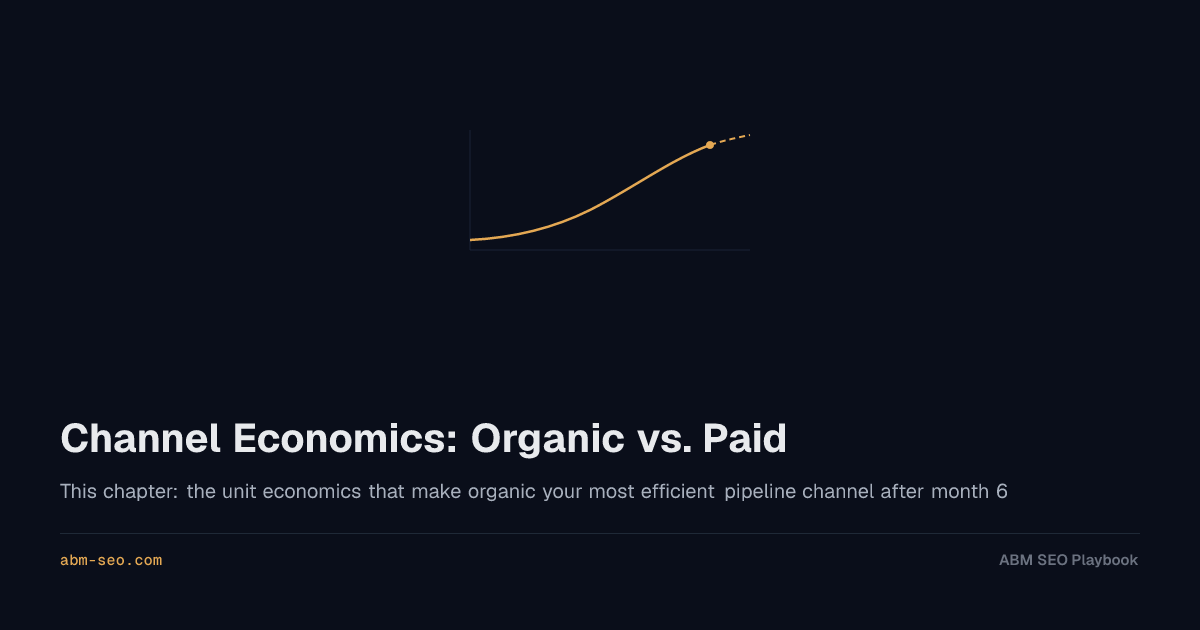
- The crossover: the month where cumulative organic MQLs overtake cumulative paid MQLs at the same budget. For most B2B segment clusters, this happens between month 7 and month 10.
- After the crossover, each additional organic MQL costs less than the last because published content keeps producing. Paid cost per MQL stays flat or rises.
- This isn't an argument against paid. It's an argument for portfolio allocation: paid for immediate pipeline, organic for compounding pipeline.
You know your paid CAC by segment. You know your event cost per lead. You probably know your SDR cost per meeting. Can you say the same for organic?
If you can’t, organic is the missing column in your channel mix spreadsheet. Not because the data doesn’t exist, but because most organic programs aren’t structured to produce it. When organic is segment-organized and measured in MQLs per segment (not traffic), the comparison becomes straightforward. And the results tend to surprise CMOs who’ve written off organic as “hard to measure.”
The math: organic CAC vs. paid CAC
Section titled “The math: organic CAC vs. paid CAC”The cost structure of organic is fundamentally different from paid, and the difference matters for how you plan.
Paid acquisition cost structure: You spend €X per month on ads. You get Y leads. Cost per lead = €X / Y. Next month, same thing. The relationship is direct and immediate. If you stop spending, leads stop.
Organic acquisition cost structure: You spend €X producing a content cluster (one-time production cost). For months 1-5, that cluster produces few or no leads (the maturity ramp). From month 6 onward, the cluster produces Y leads per month at no additional production cost. The one-time investment keeps paying.
To compare the two channels fairly, you need to amortize organic’s production cost over time. Here’s how that works for a single segment cluster:
Content cluster investment: €15K (9 pages, research, production, optimization)
Month 1-3: Cluster is maturing. MQLs: ~2 total. Effective cost per MQL: €7,500.
Month 6: Cluster at steady state. MQLs: ~18/month. Cumulative MQLs: ~55. Effective cost per MQL: €273.
Month 12: MQLs still at ~18/month. Cumulative MQLs: ~163. Effective cost per MQL: €92.
Month 18: Cumulative MQLs: ~271. Effective cost per MQL: €55.
Compare that to paid at the same €15K budget. At a paid CAC of €200 per MQL (typical for B2B segments), €15K buys you 75 MQLs. Same number whether you spend it in month 1 or month 18. No compounding.
The crossover
Section titled “The crossover”The crossover point is the month where cumulative organic MQLs overtake cumulative paid MQLs, assuming the same total budget spent on each.
Before the crossover, paid is producing more cumulative leads. This is expected. Paid has no ramp. Organic does.
After the crossover, organic pulls ahead and the gap widens every month. The slope of the organic line keeps increasing (compounding) while the slope of the paid line stays constant (linear).
The exact crossover month depends on three variables:
- Content maturity speed: Faster-maturing content (lower competition, strong domain authority) crosses over sooner
- Organic MQL rate at steady state: Higher conversion rates accelerate the crossover
- Paid CAC: Higher paid costs mean organic crosses over sooner
For most B2B segment clusters, the crossover falls between month 7 and month 10. If it falls later than month 12, either the segment doesn’t have enough search demand, competition is too strong for realistic ranking targets, or conversion rates are too low to justify the organic investment.
The incremental cost curve
Section titled “The incremental cost curve”This is where the economics become most compelling, and most different from paid.
In paid acquisition, the cost of each additional MQL tends to stay flat or rise over time. Audiences fatigue. Bid competition increases. The best-performing segments get more expensive as competitors discover them.
In organic, the cost of each additional MQL from an existing cluster drops toward zero. The content is already published. It’s already ranking. Each new month’s MQLs cost nothing incremental to produce. The only ongoing costs are maintenance: monitoring, occasional content refreshes, technical upkeep. These are a fraction of the original production cost.
At month 12, a content cluster that cost €15K to build and produces 18 MQLs/month has a marginal cost per MQL near zero. The total cost per MQL is €92 (total investment / total MQLs), but the marginal cost, what it costs to produce one more MQL, is close to nothing.
Paid can’t do this. Every paid MQL costs the same (or more) as the last one.
The portfolio argument
Section titled “The portfolio argument”None of this is an argument to stop running paid campaigns. Paid does things organic can’t:
- Immediate pipeline when you need leads this quarter, not in 6 months
- Precise targeting for specific accounts or personas that don’t yet search for your category
- Testing velocity for messaging, positioning, and offer optimization
- Event-driven spikes when you need leads around a product launch or seasonal moment
The smart allocation isn’t either/or. It’s a portfolio that shifts over time:
Early stage (months 1-6): Paid carries the pipeline load. Organic is being built and maturing. Budget split might be 80/20 paid/organic.
Mid stage (months 7-12): Organic clusters start contributing. Paid still dominates but organic is growing. Budget split shifts toward 60/40.
Mature stage (month 12+): Organic is producing at scale with declining marginal cost. Paid is used tactically for specific campaigns and new segment entry. Budget split might reach 40/60.
The exact ratios depend on your business. The principle is consistent: paid for immediate demand capture, organic for compounding infrastructure. Over time, the infrastructure carries more of the load.
The boundary: measurement comes first
Section titled “The boundary: measurement comes first”Everything in this analysis depends on one prerequisite: organic is measured in MQLs per segment, not in traffic.
If your organic program reports “20,000 sessions this month” and your paid program reports “75 MQLs this month,” you’re comparing weather to business metrics. The comparison isn’t meaningful, and it will always make organic look worse because traffic is a vanity metric and MQLs are not.
The measurement infrastructure, CRM attribution by channel and segment, conversion tracking on segment-specific landing pages, quarterly calibration of the forecast model, has to exist before the comparison is fair. If it doesn’t exist yet, building it is the first investment, not the content.
What comes next
Section titled “What comes next”Once the channel economics justify the organic investment, the question becomes operational: how do you manage the organic program against its forecast, calibrate quarterly, and build the track record that earns expanded budget?
That’s the quarterly review cadence, the management rhythm that turns a one-time business case into an ongoing proof point.
If you haven’t built the forecast model yet, start with the MQL Prediction Model. The channel economics comparison only works when you have segment-level MQL projections to compare against your paid numbers. And if you’re still evaluating whether organic belongs in the revenue conversation at all, the structural argument lays out what changes when content is organized by buyer segment.
Get notified when new chapters publish
Summarize with AI