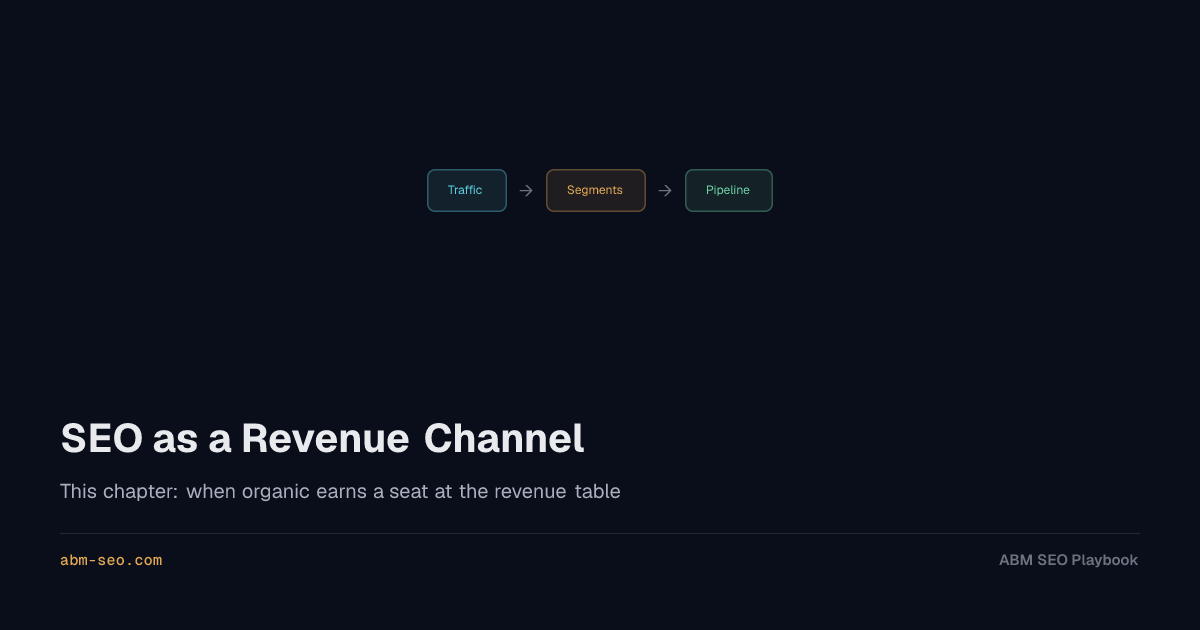
SEO as a Revenue Channel
 Floryn
  Backbase
  Insify
  Mollie
 - Most organic programs can't answer 'how many leads did SEO produce from the healthcare segment this month?' That's the gap.
- The disconnect isn't a flaw of SEO as a channel. It's a flaw of how most SEO programs are organized: by topic instead of by buyer.
- Paid stops producing when you stop spending. Organic accumulates. But only if it's structured to produce something worth measuring.
- Organic isn't right for every B2B company. The honest qualification: defined segments, sufficient deal size, and patience for a 4-8 month ramp.
Paid gives you attribution tomorrow. Organic gives you traffic charts and promises. If that’s your experience with SEO, your skepticism is earned.
Most B2B organic programs operate like this: the SEO team publishes content organized by topic (“What is procurement software?”, “Supply chain trends 2026”), reports on traffic and keyword rankings, and occasionally claims credit for leads that happened to touch an organic page somewhere in their journey. The CMO looks at the dashboard, sees growing visitor numbers with flat pipeline contribution, and reasonably concludes that organic is a brand-awareness play at best.
That conclusion is correct about most organic programs. It is not correct about organic as a channel.
The difference is organizational. When content is organized by topic, it attracts traffic that is broad, unfocused, and nearly impossible to attribute to pipeline. When content is organized by buyer segment, the same channel produces traffic that converts at 2-3x higher rates because the visitor landed on a page built for their specific situation.
The question organic can’t answer (and should)
Section titled “The question organic can’t answer (and should)”Here’s a test. Ask your SEO team: “How many MQLs did organic produce from the healthcare segment this month?”
If they can answer that question with a number, organic is already operating as a revenue channel for you. You probably don’t need this page.
If they can’t, the issue isn’t that organic doesn’t produce leads. It might. The issue is that the program isn’t structured to track them by segment, because the content isn’t organized by segment in the first place. You can’t measure what you didn’t build.
This is the fundamental difference between topic-organized SEO and segment-organized SEO. Topic-organized content targets keywords. Segment-organized content targets buyers, validated by keywords. The first produces traffic. The second produces traffic that your CRM can trace back to a specific market you’re trying to win.
What changes when content is segment-organized
Section titled “What changes when content is segment-organized”Three things happen when you reorganize organic around buyer segments.
Conversion rates go up. A VP of Operations at a construction equipment company landing on a page about fleet utilization and seasonal demand patterns converts at 2-3x the rate of the same person landing on a generic “procurement best practices” page. The content matches their context, which means the CTA matches their stage, which means the lead is qualified by the content itself.
Competitive positioning narrows. Generic “procurement software” content competes against every vendor in the category. “Construction procurement” content competes against the handful of vendors who bothered to build segment-specific pages. In most B2B verticals, that’s a much smaller field.
Attribution becomes possible. When each piece of content belongs to a defined segment, you can trace the path: this person landed on a construction-segment page, converted on the construction landing page, entered the CRM as a construction-segment MQL. The attribution model works because the content architecture was designed for it.
The accumulation argument
Section titled “The accumulation argument”This is the part most CMOs intuitively understand but rarely see quantified.
A paid campaign that produces 20 MQLs in month 1 produces zero in month 2 when you turn it off. A content cluster that produces zero MQLs in month 1 produces 15-25 per month from month 6 onward, without additional spend.
Paid acquisition is a faucet. Turn it on, leads flow. Turn it off, they stop. The unit economics are predictable but linear: spend €10K this month, get X leads. Spend €10K next month, get X leads again. There’s no compound effect.
Organic, when structured correctly, is infrastructure. The first six months are investment with minimal return (the maturity ramp). After that, every published page continues producing leads without incremental cost. The cost per additional MQL drops every month because the denominator keeps growing while the numerator stays fixed.
This isn’t an argument against paid. It’s an argument for portfolio allocation. Run paid for immediate pipeline. Build organic for compounding pipeline. The smart CMO does both, but shifts the mix as organic matures and the unit economics become undeniable.
When organic isn’t the right investment
Section titled “When organic isn’t the right investment”Honesty about boundaries builds more credibility than overselling.
Organic isn’t right if you don’t have defined ABM segments. The entire model depends on knowing who you’re building content for. If your go-to-market is horizontal (“we sell to everyone”), segment-organized content doesn’t have a foundation.
It’s not right if your average deal size doesn’t justify the investment. A 9-page content cluster costs roughly €10K-20K to produce well. If your average deal is €5K, the payback math is challenging. If it’s €45K+, one closed deal from the cluster pays for the entire investment.
It’s not right if you need pipeline this quarter. The maturity ramp is real: 4-8 months before a new content cluster reaches steady-state production. If your planning horizon is 90 days, paid is the right tool. If you can plan in 6-12 month cycles, organic becomes viable.
And it’s not right if your CRM can’t support segment-level attribution. The forecast model, the measurement framework, the quarterly review cadence, all of it depends on being able to answer “how many organic MQLs came from segment X this month?” If your attribution infrastructure can’t do that, build the infrastructure first.
The question to ask yourself
Section titled “The question to ask yourself”If organic could report in pipeline terms, segment by segment, month by month, with a forecast you could hold it accountable to, would it earn more of your marketing budget?
If the answer is yes, the issue isn’t organic as a channel. It’s how your organic program is currently structured. That’s what ABM SEO changes, and the restructuring doesn’t require new budget. It requires redirecting the investment you’re already making.
If you want to see what the restructured version produces in concrete numbers, the MQL Prediction Model walks through the forecast mechanics with a worked example: nine pages, one segment, projected pipeline.
Get notified when new chapters publish
Summarize with AI