ABM SEO vs Traditional SEO
 Floryn
  Backbase
  Insify
  Mollie
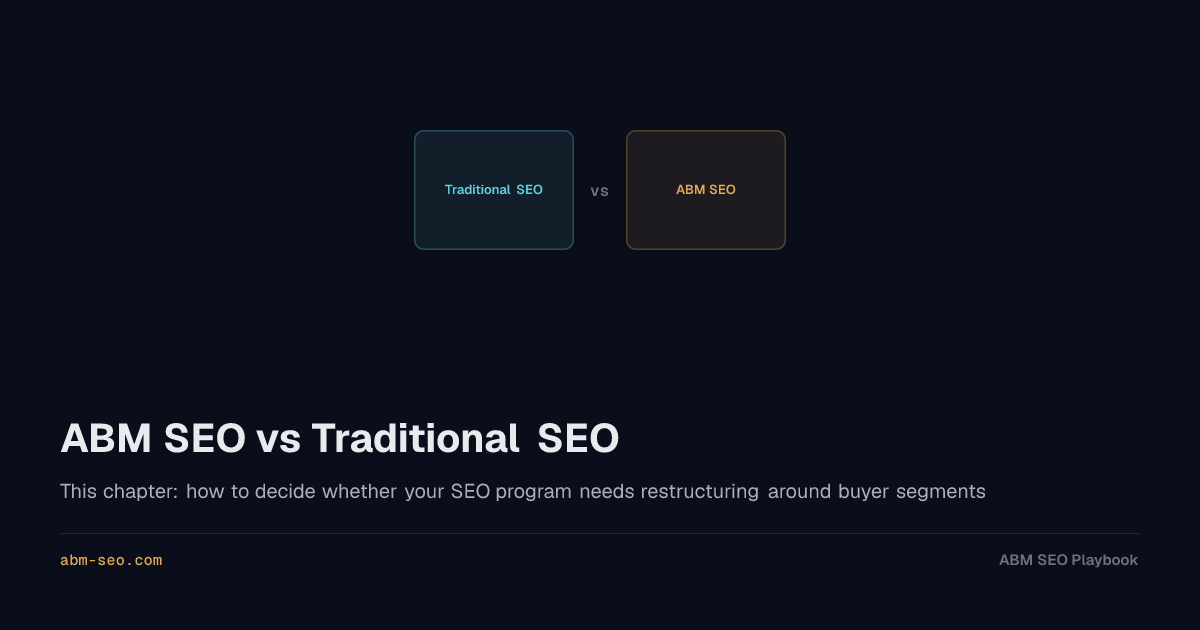
 - The most important difference is the starting point: ABM SEO starts with audiences and works forward to keywords
- Each segment's content is anchored by two primary pages with distinct purposes: a landing page and a pillar page
- The technical fundamentals of SEO don't change, the shift is in how you organize and prioritize
| Traditional SEO | ABM SEO | |
|---|---|---|
| Organizing principle | Keywords and topics | Buyer segments with keyword validation |
| Content structure | Topic clusters (hub and spoke around a theme) | Segment clusters (content for a specific buyer type across the full funnel) |
| Prioritization | Search volume, keyword difficulty, topical authority | Commercial relevance of the segment, validated by search demand |
| Primary input | Keyword research tools | CRM data and sales conversations, validated by keyword tools |
| Success metrics | Traffic, rankings, organic sessions | Segment-level MQLs, pipeline attribution, conversion rate by segment |
| Content depth | Depends on topic complexity | Depends on buying journey complexity per segment |
| Stakeholder language | ”We rank #3 for this keyword" | "Organic is driving X MQLs per month from the healthcare segment” |
The most important difference is the starting point. Traditional SEO starts with keywords and works backward to audiences. ABM SEO starts with audiences and works forward to keywords. This seems like a subtle distinction, but it fundamentally changes what content gets produced and how resources are allocated.
The two-page architecture
Section titled “The two-page architecture”In ABM SEO, each segment’s content is anchored by two primary pages with distinct purposes:
-
The Landing Page is a conversion asset. It targets product-heavy, high-intent keywords, the queries people make when they’re ready to evaluate or buy. It has strong CTAs, social proof, and minimal navigation away from the conversion action. Think of it as your ABM conversion endpoint.
-
The Pillar Page is an authority asset. It provides comprehensive, educational content about the segment’s core topic. It targets broader informational and commercial keywords, serves as the internal linking hub for the cluster, and builds the topical authority that helps all pages in the cluster rank.
The pillar page links to the landing page as the conversion endpoint. The landing page benefits from the authority the pillar page builds. They’re complementary, not competing.
When to use a single page instead: When the segment is niche enough that search volume is low, when splitting would dilute authority across two thin pages, or when the buying journey is short enough that education and conversion can coexist on one page.
Where to start
Section titled “Where to start”If ABM SEO is the right fit, the next step depends on where you are.
You need to find your segments. Start with CRM-Driven Segment Discovery. Your CRM data tells you which buyer types are already converting from organic, often in segments nobody intentionally targeted.
You know your segments and need the content architecture. The Content Cluster Architecture covers the Minimum Viable Cluster: what to build, how many pages, and in what sequence.
Other perspective ABM SEO vs Traditional SEO: The Investment Decision Same comparison, framed as capital allocation. Written for CMOs evaluating whether to restructure.Get notified when new chapters publish
Summarize with AI