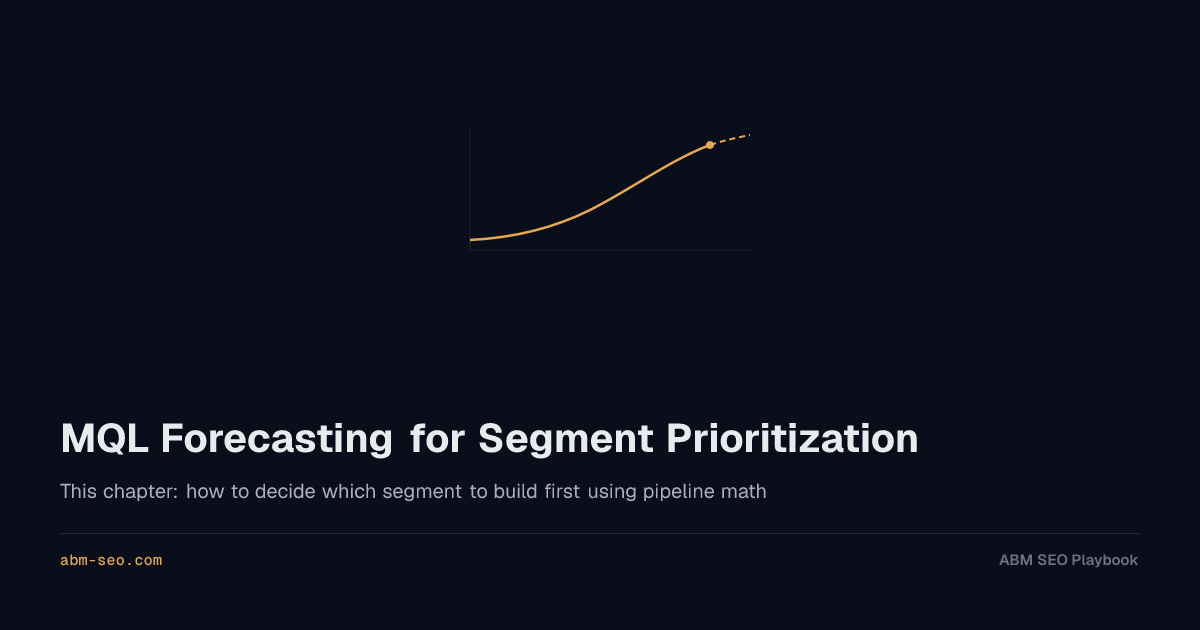
MQL Forecasting for Segment Prioritization
 Floryn
  Backbase
  Insify
  Mollie
 - Running the model across segments before you produce anything reveals where the highest MQL yield per page lives
- The forecast gives you a sequencing tool, not just a projection: build the segment with the best ratio of effort to pipeline first
- Maturity curves mean your first cluster starts producing before your second cluster is even published
- Forecast-vs-actuals is how you run the monthly prioritization conversation with your team
You have three segments identified. Your CRM data supports all of them. You have budget for content production, but not enough to build all three at once. Which one do you start with?
Most growth teams answer this with gut feel, loudest-stakeholder-wins, or “whichever segment the sales team is complaining about this quarter.” None of these are wrong exactly, but none of them are defensible either. When the CMO asks “why healthcare first and not logistics?” you need a better answer than “it felt right.”
The MQL Prediction Model gives you that answer. Not by predicting the future with false precision, but by making the assumptions behind each segment explicit and comparable.
The model as a prioritization tool
Section titled “The model as a prioritization tool”The CMO version of this model exists to justify budget to a CFO. Your version exists to decide what to build and in what order.
The mechanics are the same six layers: search demand, click-through rate, sessions, maturity ramp, conversion rate, scenario ranges. What changes is what you do with the output.
Instead of modeling one segment to build a business case, you model all your candidate segments side by side. The comparison surface is what matters.
Running the comparison
Section titled “Running the comparison”For each candidate segment, you need:
- A keyword map for the planned cluster (8 to 10 pages, with primary keyword and monthly volume per page)
- A target position estimate per page (informed by competitive analysis, not wishful thinking)
- Your funnel-stage conversion rates (from existing organic data, or conservative starting estimates)
Then run the model for each segment independently. The output is a table like this:
| Segment | Pages | Total volume | Projected MQLs (baseline, month 8) | MQLs per page |
|---|---|---|---|---|
| Healthcare | 9 | 4,200 | 18 | 2.0 |
| Logistics | 9 | 2,800 | 22 | 2.4 |
| Construction | 9 | 3,570 | 15 | 1.7 |
The gut-feel answer was healthcare because it has the most search volume. The model says logistics, because the keyword intent is more commercial (higher CTRs, higher conversion rates) and competition is thinner (more realistic position targets).
Search volume is a terrible proxy for pipeline. The model forces you to look at the full chain from impressions to MQLs, and the ranking often surprises you.
The MQLs-per-page ratio
Section titled “The MQLs-per-page ratio”The single most useful number for prioritization is MQLs per page at steady state. This is your efficiency metric: how much pipeline does each piece of content produce?
A segment with 2.4 MQLs per page beats a segment with 2.0 MQLs per page even if the second segment has more total volume. You’re optimizing for pipeline per unit of effort, not total addressable search volume.
This ratio also tells you something about the quality of the segment’s keyword landscape. High MQLs-per-page means: commercial intent is concentrated, competition allows realistic ranking targets, and conversion rates are strong. Low MQLs-per-page means: the keywords are informational, the SERP is crowded, or your conversion funnel for that audience hasn’t been proven yet.
Sequencing with maturity curves
Section titled “Sequencing with maturity curves”The maturity curve is the reason sequencing matters at all. New content doesn’t perform on day one.
This means your first cluster starts producing MQLs at month 3 to 4 while your second cluster is still being built. If you sequence correctly, you create a staggered ramp where each cluster reaches steady state as the next one starts delivering.
A practical timeline:
- Months 1 to 2: Publish cluster 1 (logistics, your highest MQLs-per-page segment)
- Months 3 to 4: Publish cluster 2. Cluster 1 is at 50% of steady state, already producing leads.
- Months 5 to 6: Publish cluster 3. Cluster 1 is at full run-rate. Cluster 2 is ramping.
- Month 8+: All three clusters at or near steady state. Compounding.
If you build all three simultaneously and publish everything in month 1, you get the same eventual output but a longer period of low production while everything ramps in parallel. Sequential building with the highest-yield segment first gets you to meaningful pipeline numbers faster.
The monthly prioritization conversation
Section titled “The monthly prioritization conversation”Once you’re in production, the forecast becomes your operating rhythm. Every month, you compare forecast to actuals per segment and per funnel stage.
The conversation is structured:
Is the gap in traffic or conversion?
If a segment is underperforming, one of two things is happening. Either you’re getting less traffic than forecasted (ranking or CTR problem) or traffic is arriving but not converting (content-to-intent alignment or CRO problem). These are different problems with different solutions.
Which lever has the highest impact right now?
Your team has finite capacity. The forecast gap tells you where to focus:
- Segment 1 is 30% below traffic forecast: internal linking and backlink work for that cluster
- Segment 2 is on track for traffic but conversion is 40% below: landing page optimization, CTA review, intent alignment
- Segment 3 is ahead of forecast: leave it alone, allocate resources elsewhere
Without the forecast, the monthly conversation becomes “what should we work on?” and the answer is whatever feels urgent. With the forecast, the answer is data-driven: close the biggest gap first.
What this version doesn’t cover
Section titled “What this version doesn’t cover”This page is about what you do with the model’s output: prioritize, sequence, and run the monthly operating rhythm. If you need the mechanics or the business case, see the other perspectives below.
Other perspective The MQL Prediction Model The full six-layer calculation chain, worked examples, and the business case for your CFO. Written for CMOs. Other perspective MQL Forecasting: The Spreadsheet How to build and maintain the model: GSC data pulls, CTR calibration, scenario setup, quarterly recalibration. Written for SEO Leads.The honest constraint
Section titled “The honest constraint”The model is only as good as your assumptions, and your assumptions are only as good as your data. If you’ve never run organic content for a segment, your conversion rate estimate is a guess. An informed guess, calibrated against similar segments, but still a guess.
That’s fine. The model’s value isn’t precision. It’s comparability. Even with rough assumptions, running the same model across three segments with the same methodology gives you a defensible ranking. As actuals come in, the assumptions get sharper. By quarter 2, your forecasts are calibrated. By quarter 3, they’re genuinely predictive.
The teams that never build a model aren’t more honest. They’re just making the same guesses without writing them down.
Forecasting is one piece of the full ABM playbook, which covers how to go from segment discovery through content architecture to the operating rhythm that connects organic to pipeline.
Get notified when new chapters publish
Summarize with AI