Segment Linking Architecture
 Floryn
  Backbase
  Insify
  Mollie
 - Internal links in ABM SEO follow the buyer journey: TOFU feeds MOFU, MOFU feeds BOFU, BOFU feeds the landing page
- 80% or more of your internal links stay within the segment cluster. Cross-segment links only at TOFU level.
- When a segment underperforms your MQL forecast, internal link count is one of the first diagnostics to run
- Anchor text changes by funnel stage: industry-oriented at TOFU, problem-oriented at MOFU, product-specific at BOFU
You built the cluster. You published nine pages for a segment, each targeting the right keyword at the right funnel stage. The content is strong. But three months in, the cluster is underperforming your MQL forecast. Pages are indexed but ranking on page two. The pillar page, which should be your authority anchor, is stuck at position 14.
The problem is almost never the content. The problem is that your pages don’t know they belong together. Without a deliberate linking architecture, search engines see nine loosely related articles. With one, they see a coherent cluster about a specific topic for a specific audience. That distinction is the difference between page two and position four.
The segment linking hierarchy
Section titled “The segment linking hierarchy”Every segment cluster has a natural link flow that mirrors how a buyer moves from awareness to decision. The structure is not complicated, but it is specific, and most teams get it wrong by linking too freely across stages and clusters.
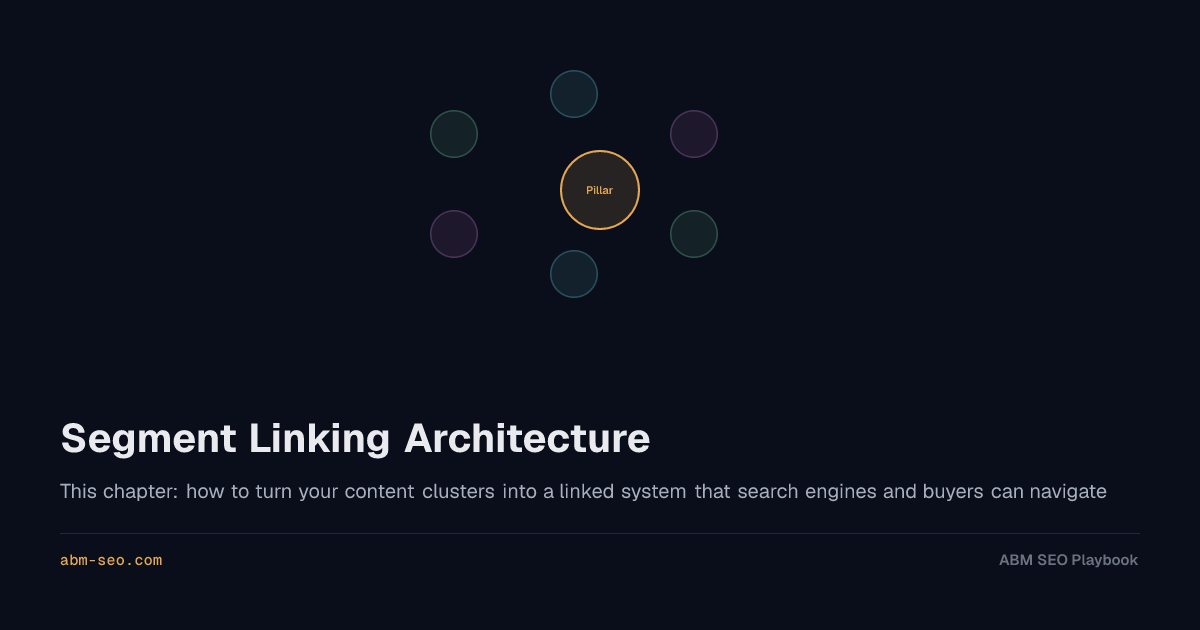
The hierarchy works like this. TOFU pages link forward to MOFU pages. MOFU pages link forward to BOFU pages. BOFU pages link to the landing page (your conversion point). And the pillar page sits at the center, linking to everything in the cluster while receiving links from everything in return.
The landing page is the exception. It receives links from BOFU pages and from the pillar, but it links out minimally. Its job is conversion, not navigation. Every outbound link on a landing page is a potential exit before the form fill.
Notice what this diagram does not show: BOFU pages linking back to TOFU pages, or TOFU pages linking directly to the landing page. Those paths exist for users who want them (through the pillar or through the sidebar navigation), but the contextual internal links within your body copy follow the buyer’s direction of travel. Awareness leads to consideration leads to decision. Your links should do the same.
The pillar page is the exception to the directional rule. It links to every page in the cluster regardless of funnel stage, and every page links back to it. This creates a hub-and-spoke pattern that concentrates topical authority on the pillar while distributing it outward to the cluster pages. When the pillar ranks, it pulls the cluster up with it. When cluster pages earn backlinks, the authority flows through to the pillar.
In practice, this means every methodology chapter in a cluster should contain at least one contextual link to the pillar page and at least one link to the next logical page in the funnel sequence. Two links minimum per page, both deliberate.
Cross-segment linking rules
Section titled “Cross-segment linking rules”This is where ABM SEO diverges sharply from generic internal linking advice. Most SEO guidance says “link to related content wherever it’s relevant.” In a segment cluster model, that instinct will destroy your architecture.
The rule: 80% or more of a page’s internal links point within its own segment cluster. Cross-segment links are sparse by design, and they follow strict constraints.
Cross-segment links are acceptable at TOFU level only. A TOFU page in the CMO cluster can reference a concept that’s also covered in the Growth cluster, and a contextual link there is fine. The reader is still in exploration mode, and the content genuinely overlaps at the awareness stage.
Cross-segment links are never acceptable at BOFU level. A BOFU page for CMOs is tuned to a CMO’s decision context. Linking to a Growth page at that stage pulls the reader out of their conversion path and into content written for someone else. The intent mismatch costs you the lead.
Never link to another segment’s landing page. Each landing page is optimized for one audience with one conversion message. Sending a CMO to a Growth landing page (or vice versa) guarantees a bounce.
The one exception is shared methodology content. If the site has a frameworks section that serves all audiences equally (like a decision tree or a template), any page can link there regardless of segment or funnel stage. Frameworks are audience-neutral tools. Segment pages are not.
Internal linking as an MQL diagnostic lever
Section titled “Internal linking as an MQL diagnostic lever”Here is where internal linking connects to the operating rhythm described in the MQL forecasting chapter. When a segment underperforms your forecast, you need a diagnostic sequence. Internal link count is one of the first things to check.
The logic is straightforward. If a segment is below forecast, the gap lives in one of two places: traffic or conversion. If the gap is in traffic, the problem is either ranking or click-through rate. If the problem is ranking, one of the most common causes is insufficient internal link authority flowing to the underperforming pages.
The audit itself is simple. Pull up your crawl data (Screaming Frog, Sitebulb, or Ahrefs Site Audit all work) and count the internal links pointing to each page in the underperforming cluster. Compare that count to your other clusters. If your logistics cluster has an average of 12 internal links per page and your healthcare cluster has 4, you’ve found a likely contributor.
The fix is not to spray links from random pages. Find your highest-authority pages (by backlink count or URL Rating) and add contextual, relevant links from those pages to the underperforming cluster’s pillar and BOFU pages. Authority flows through internal links. You’re directing that flow where it’s needed most.
Anchor text by funnel stage
Section titled “Anchor text by funnel stage”The text you use in your internal links is not random. It signals to search engines what the target page is about, and it signals to readers what they’ll find when they click. Both signals should match the funnel stage of the target page.
| Funnel Stage | Anchor Text Style | Example |
|---|---|---|
| TOFU | Industry or topic-oriented | ”construction procurement challenges” |
| MOFU | Problem or method-oriented | ”evaluating vendor management approaches” |
| BOFU | Product or solution-specific | ”procurement software comparison for contractors” |
| Pillar | Segment + methodology | ”the construction procurement playbook” |
| Landing | Action-oriented | ”get started with construction procurement SEO” |
The reasoning: at TOFU, the reader is thinking in terms of their industry and broad challenges. At MOFU, they’re thinking about specific problems and methods to solve them. At BOFU, they’re comparing options and looking at specific solutions. Your anchor text should match the mental frame of the page it points to, not the page it sits on.
Do not overthink this. If a link appears naturally in a paragraph about vendor evaluation and it points to your MOFU page about streamlining purchasing workflows, the surrounding context already does most of the signaling work. The anchor text just needs to be descriptive and honest about what’s on the other side. Avoid generic anchors like “click here” or “read more” because they waste a signal opportunity, but also avoid stuffing exact-match keywords into every link. Write for the reader first. The search engine signal is a side effect of good writing.
What internal linking will not fix
Section titled “What internal linking will not fix”A strong linking architecture amplifies good content and a sound segment strategy. It does not compensate for their absence.
Thin content. If a page has 400 words of generic advice, no amount of internal links will make it rank. The page needs substance before it needs links.
Wrong segments. If your CRM data doesn’t support the segment you’ve built a cluster for, internal linking won’t create demand that doesn’t exist. Go back to segment discovery and validate before optimizing.
Missing search demand. Some segments are real business opportunities with no meaningful search volume. Internal linking can’t manufacture organic traffic for keywords nobody searches. In those cases, the content serves a different purpose (sales enablement, nurture sequences) and the linking architecture matters less.
Technical SEO problems. If pages are blocked by robots.txt, returning 404s, or suffering from crawl budget issues on a large site, internal links won’t reach their targets. Fix the infrastructure first.
Internal linking is a multiplier. It multiplies what’s already working. If nothing is working yet, the multiplier is zero.
Other perspective Internal Linking Strategy: The Operational Playbook How to audit, build, and maintain internal links step by step. Screaming Frog workflow, anchor text rules, maintenance cadence. Written for SEO Leads.Get notified when new chapters publish
Summarize with AI