The Content Cluster Architecture
 Floryn
  Backbase
  Insify
  Mollie
 - A Minimum Viable Cluster consists of 8-10 pieces: landing page, pillar page, and funnel-stage content
- The Content Matrix maps segments (columns) against content types (rows) to plan and track production
- Build vertical-first: complete one full cluster before expanding to the next segment
Once you’ve identified and prioritized a segment, the next question is: what content do you actually need to build?
The Minimum Viable Cluster
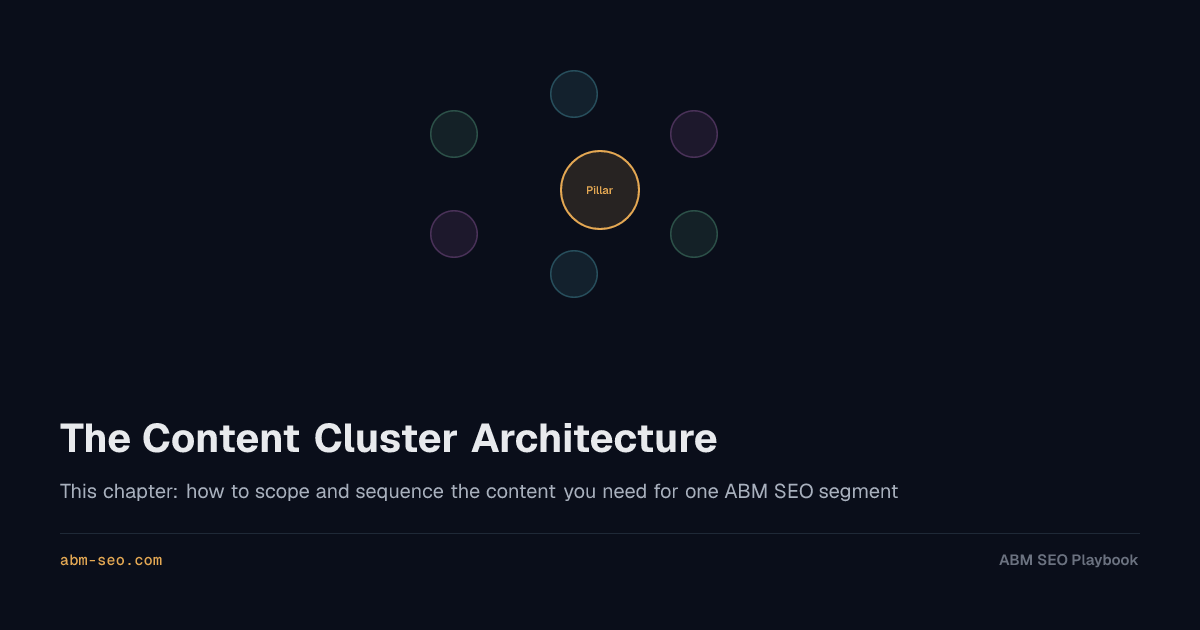
Section titled “The Minimum Viable Cluster”A common mistake in content strategy is trying to build everything at once, or worse, building a single page and expecting it to rank. ABM SEO uses the concept of a Minimum Viable Cluster (MVC), i.e. the smallest set of content that provides meaningful organic coverage for a segment.
An MVC consists of 8-10 pieces:
-
Landing Page (1 piece) — Conversion-focused, targeting product-heavy keywords. Strong CTAs, social proof, minimal distraction. This is where segment visitors convert.
-
Pillar Page (1 piece) — Comprehensive authority content. The internal linking hub. Targets broader educational and commercial keywords for the segment.
-
Bottom-Funnel Content (2-3 pieces) — Comparison pages (“your product vs. competitor X” for this segment), alternative pages, pricing/ROI content, segment-specific case studies. These capture buyers who are actively evaluating.
-
Mid-Funnel Content (2-3 pieces) — How-to guides, evaluation frameworks, best practices, use case deep-dives. These help buyers who know they have a problem but are still figuring out how to solve it.
-
Top-Funnel Content (2-3 pieces) — Industry trends, educational explainers, problem-awareness content. These capture people who don’t yet know they need your product but are searching around the edges of the problem.
Why 8-10 pieces?
Section titled “Why 8-10 pieces?”This number isn’t arbitrary. It’s the threshold where several things happen simultaneously:
-
You have content at every stage of the buying journey, which means you can capture demand from awareness through to decision, not just bottom-funnel.
-
You create enough internal linking density to signal topical authority to search engines. A single page about a segment is a data point. Ten interlinked pages about a segment is a signal that you have genuine depth. (The linking architecture chapter covers how to structure those links.)
-
You avoid diluting crawl budget and link equity across dozens of thin pages. Each piece in the cluster should be substantial and earn its place.
And critically, it gives you a clear “done for now” threshold. The MVC tells the team: build these 8-10 pieces, publish them, and then wait for performance data before deciding whether to expand. This prevents the common failure mode of producing endless content without measuring whether any of it is working.
The Content Matrix
Section titled “The Content Matrix”To plan and track production across multiple segments, ABM SEO uses a Content Matrix; a simple visual framework where columns represent segments and rows represent content types.
| Landing Page | Pillar Page | Bottom-Funnel | Mid-Funnel | Top-Funnel | |
|---|---|---|---|---|---|
| Segment A | |||||
| Segment B | |||||
| Segment C |
This matrix makes two strategic approaches visible:
-
Vertical-first: Build the complete MVC for one segment before moving to the next. This is the recommended starting approach because you learn the most from completing one full cluster: what works, what the production process looks like, how long it takes, and how the content performs.
-
Horizontal expansion: After the first segment is complete, create the top-level pages (landing page + pillar page) across multiple segments, then progressively deepen each cluster. This establishes organic presence across segments faster, but with less depth per segment.
The optimal approach is vertical-first for your first segment, then horizontal for expansion. Build one full cluster, learn from it, and use those learnings to accelerate the next segments.
As you expand to multiple segments, the critical discipline becomes genuine content differentiation. When the same methodology concept appears in multiple clusters, each version must be written from that ICP’s specific entry point, not copied with swapped industry terms.
Why clusters win AI citations
Section titled “Why clusters win AI citations”Segment-organized clusters have a structural advantage that topic-organized content lacks, and it matters increasingly as AI Overviews replace clicks.
When an LLM answers a query about “procurement software for construction companies,” it looks for sources that are specific, authoritative, and well-structured on that exact topic. A segment-specific page backed by a cluster of supporting content, with clear internal linking and consistent semantic signals, is more citable than a generic page competing with thousands of similar ones.
What gets cited in AI-generated answers: named frameworks with clear structure (the “Minimum Viable Cluster,” the “Content Matrix”), specific data points tied to identifiable situations, tables and ordered processes a model can extract cleanly, and author authority signals the model can use to weight the source.
The cluster’s internal linking reinforces this. When related pages about a specific topic for a specific audience are clearly connected, the AI system has more confidence that the source has genuine depth, not just a single page on the subject.
The extraction test matters here: strip a page of all visual presentation and read the raw text. Does the message still land? If the value proposition only works inside your design system, it will not survive being pulled into an AI Overview. Content that passes the non-commodity test tends to survive extraction because its value is in the substance.
One practical move most teams miss: Google allows users to mark websites as “Preferred Sources,” which prioritizes your content across Top Stories, AI Mode, and AI Overviews for that user. The URL pattern is google.com/preferences/source?q=[YOUR_WEBSITE]. Encourage this from newsletters, post-conversion pages, and email signatures.
For the full methodology, including segment discovery and forecasting, see the playbook overview.
Get notified when new chapters publish
Summarize with AI