CRM-Driven Segment Discovery
 Floryn
  Backbase
  Insify
  Mollie
 - The most validated segments are often already visible in your customer data, before anyone does keyword research
- CRM deal data shows which business types convert best from organic, often in segments you haven't intentionally targeted
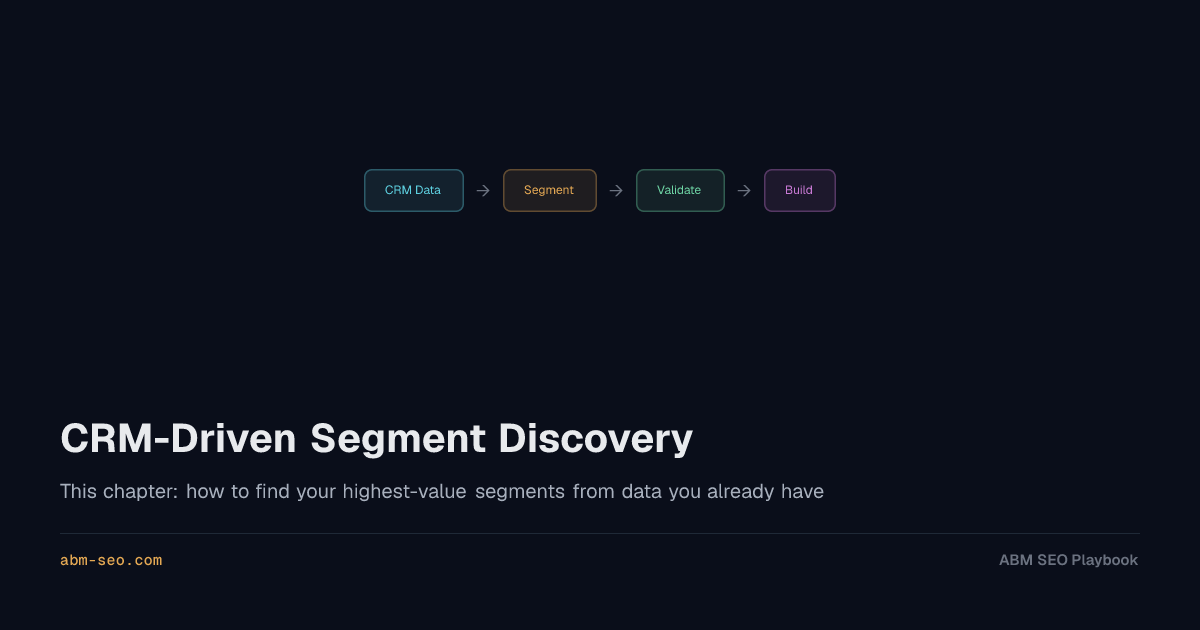
- The process: pull CRM data, segment by industry/size/use case, look for concentrations, validate with keyword research
This is where ABM SEO diverges most sharply from traditional SEO practice, and where the biggest opportunities hide.
Mining your existing data
Section titled “Mining your existing data”Your CRM, sales recordings, and support interactions contain intelligence that no keyword tool can replicate:
-
Call recordings and sales conversations (tools like Fathom or Avoma make this searchable) reveal the exact language buyers use to describe their problems. This isn’t “assumed search intent,” it’s the actual vocabulary your best customers use. These conversations also surface objections (which become FAQ and comparison content), competitors mentioned by prospects (which become “vs. competitor” pages), and use cases (which become mid-funnel content). When a prospect says “we need a way to manage our fleet utilization across multiple sites,” that’s a keyword research goldmine for the construction equipment segment.
-
CRM deal data shows which industries or business types convert best from organic traffic, and here’s the key: these are businesses that found you without you doing any SEO targeting for their segment. They landed on your site through adjacent content, liked what they saw, and converted anyway. That’s an incredibly strong signal. If they’re already converting through generic content, imagine what happens when you publish content specifically built for their industry, their pain points, their buying journey. You can only win. The practical next step is to talk to these customers directly, understand why they chose you, what they searched for, what almost stopped them, and then validate those insights with keyword research to confirm the opportunity at scale.
-
Customer support interactions surface the questions specific customer types ask most often. These become content topics with built-in search demand, because if your customers are asking, prospects are searching.
-
Organic acquisition patterns show which business types are already finding your site through search, sometimes in segments you haven’t intentionally targeted. This is unintentional traction, and it’s one of the most valuable signals you can find.
Most SEO programs start with keyword research tools. You plug in seed terms, look at search volumes, and build content around what the tools suggest. ABM SEO starts with your CRM, because the most validated segments are often already visible in your customer data, before anyone does keyword research.
The discovery process
Section titled “The discovery process”The process is straightforward:
- Pull CRM data on closed-won deals sourced or assisted by organic search
- Segment those deals by industry, company size, use case, or pain point
- Look for concentrations, are there clusters of deals from specific business types?
- For each cluster, investigate: was there intentional content targeting this segment, or did they find you through adjacent content?
- If unintentional: research whether dedicated content could accelerate this using keyword research and competitive analysis
- If the data supports it: this becomes a priority segment for the ABM SEO program, validated by actual revenue
Example: discovering a hidden segment
Section titled “Example: discovering a hidden segment”A B2B payments company noticed through CRM analysis that automotive e-commerce businesses represented a significant share of organic-sourced deals, without any intentional targeting. Nobody on the marketing team had flagged automotive e-commerce as a priority segment. But the data showed these businesses were finding the site through generic payment processing content, converting at above-average rates, and closing deals with above-average contract values.
By researching the keyword landscape for “automotive e-commerce payment solutions” and related terms, they confirmed that search demand existed but competition was low; no one was creating dedicated content for this intersection. Creating targeted content for this segment attracted higher-quality leads and accelerated pipeline growth in a segment nobody had consciously prioritized.
The market tells you the segment exists. The CRM validates it. Keyword research confirms the opportunity. Content captures the demand.
This is step one of the playbook overview. The principle behind starting with CRM data rather than keyword tools is context-first SEO: the buyer’s context determines what content to create, not the search volume. Once you have validated segments, the next step is building the content cluster for your highest-priority segment.
Get notified when new chapters publish
Summarize with AI