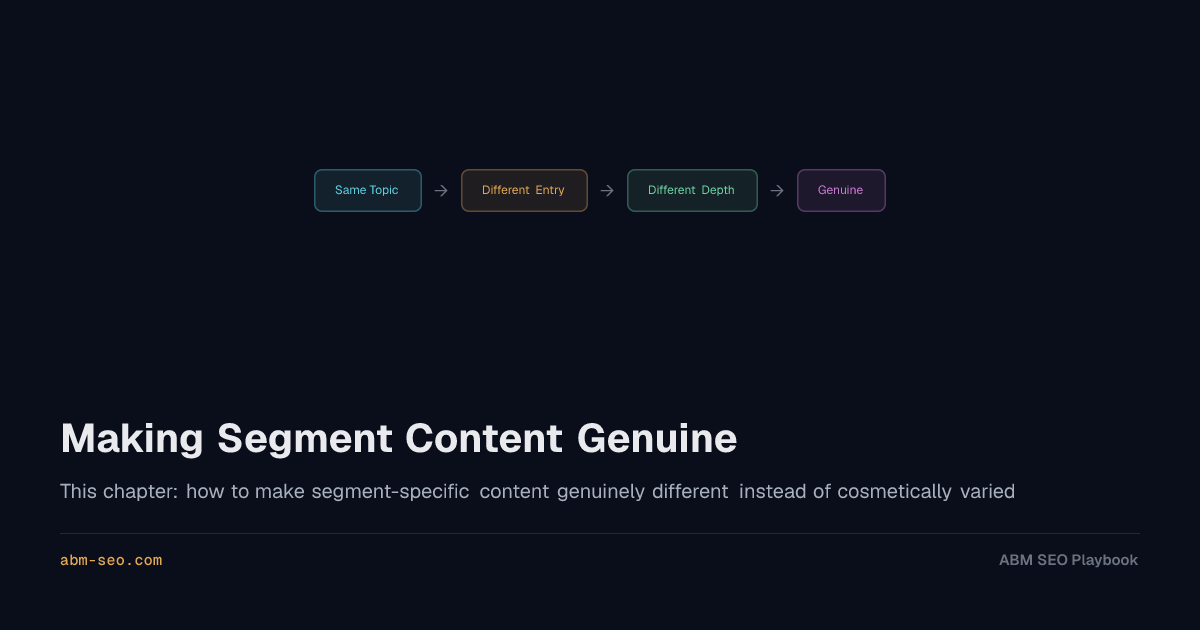
Making Segment Content Genuine
 Floryn
  Backbase
  Insify
  Mollie
 - The swap test: would a reader in this ICP find this page more useful than the version written for a different ICP? If the answer is 'about the same,' differentiation is not working.
- Four rules: lead with this ICP's problem, use examples from their world, adjust depth by expertise level, let other versions exist without apology.
- The most common violation: creating 'segment variants' by swapping industry terms in the intro paragraph while keeping the body identical.
- Same methodology concept, three genuinely different pages. Not duplicates. Not cross-links. Different entry points for different humans.
This is the hardest operational discipline in ABM SEO. Everything else in the playbook is structurally straightforward: find your segments from CRM data, build the clusters, wire the links, forecast the pipeline. Content differentiation is where teams fail, because it requires genuine editorial judgment, not just process.
The problem: when the same methodology concept applies to multiple segments, the pages must be genuinely different. Not find-and-replace copies with swapped industry terms. Not the same article republished under different segment URLs. Genuinely different pages that serve genuinely different needs.
Most teams get this wrong. They follow the playbook, build the architecture, and then fill it with cosmetically varied content. The structure is right. The substance is identical. And the conversion rates show it.
The swap test
Section titled “The swap test”One question determines whether differentiation is working:
Would a reader in this ICP find this page more useful than the version written for a different ICP?
If the answer is “about the same,” the differentiation is cosmetic. The pages look different in the URL and the H1 but deliver the same experience to the reader. A CMO landing on the “SEO Lead version” would find it roughly as useful as the version written for them. That means neither version is truly written for anyone.
Run this test on every page that exists in multiple segment variants. Pull up both versions side by side. Read the CMO version as if you were an SEO lead. If nothing feels wrong, nothing feels targeted either.
The four rules
Section titled “The four rules”1. Lead with the problem this ICP actually has
Section titled “1. Lead with the problem this ICP actually has”A CMO reading about MQL forecasting is trying to justify budget. They need to walk into a board meeting with a number and defend it. The opening paragraph should put them in that room.
A Head of Growth reading about MQL forecasting is trying to decide which segment to build first. They need to compare yield across three candidate segments and pick the one that justifies the next quarter’s content investment. The opening paragraph should put them at that decision point.
An SEO lead reading about MQL forecasting is trying to build the spreadsheet. They need the calculation chain, the GSC calibration method, the CTR curve assumptions. The opening paragraph should acknowledge that they already understand why forecasting matters and get straight to the mechanics.
Same methodology. Three different problems. Three different opening paragraphs. Three different first impressions that tell each reader “this page is for you.”
2. Use examples from this ICP’s world
Section titled “2. Use examples from this ICP’s world”Not “a typical B2B company.” Not “imagine a SaaS startup.” Specific, recognizable situations from the world the reader operates in.
For the CMO version: the board meeting where the CFO asks “if we invest 200K in content, how many leads does that produce?” and the marketing leader who cannot answer. The conversation about paid CAC versus organic CPL, stated in terms a financial audience understands.
For the Head of Growth version: the prioritization meeting where three segments all look promising and the team needs a framework to pick one. The construction procurement segment cluster that produced 15 MQLs/month from nine pages at a 45K EUR average deal size.
For the SEO lead version: the Screaming Frog crawl that revealed orphaned pages breaking the cluster. The GSC export showing CTR anomalies that signal context mismatch. The spreadsheet formula that converts keyword volume into projected MQLs through six layers.
Each set of examples creates information scent for the intended reader. A CMO sees “board meeting” and “CFO” and stays. An SEO lead sees “Screaming Frog” and “GSC export” and stays. Neither would stay on the other’s version, because the examples do not match their situation.
3. Adjust depth by expertise level
Section titled “3. Adjust depth by expertise level”The CMO version of any concept should be 40% the length of the SEO lead version. Not because CMOs cannot handle depth, but because their decision requires different information. They need the business case, the risk framing, the expected outcome, and the cost structure. They do not need the implementation mechanics. Including implementation detail in the CMO version is not thoroughness. It is noise that buries the decision-relevant material.
The SEO lead version should include the mechanics the CMO version deliberately omits. Step-by-step processes, tool configurations, audit procedures, calculation methods. The reader already understands why this matters. They need to know how to do it.
The Head of Growth version sits between the two: strategic enough to inform resource allocation, operational enough to guide team direction. They need to understand the system well enough to manage it, but they are not the one running the crawl.
4. Let the other versions exist without apology
Section titled “4. Let the other versions exist without apology”Do not try to cover all audiences in a single page. Do not add “if you’re a CMO, skip to section 4” callouts. Do not hedge the depth to satisfy everyone. Write for one reader. Link to the other versions for readers who want a different angle.
A page that tries to serve three audiences serves none.
The CMO finds it too tactical. The SEO lead finds it too strategic. The Head of Growth finds it unfocused. Each walks away thinking “this was not quite for me,” which is the worst outcome in content: close enough to keep reading, not targeted enough to convert.
Link between versions cleanly. “For the executive business case, see the CMO version. For the implementation mechanics, see the SEO lead version.” No apology, no qualification. Different pages for different people.
Concrete example: MQL forecasting across three segments
Section titled “Concrete example: MQL forecasting across three segments”This is how the same methodology concept looks when differentiated genuinely.
CMO version opens with: the CFO conversation. “If we invest in this content program, how many leads does that produce?” The page leads with the fact that organic has historically been unfundable because nobody could answer that question. It presents the MQL Prediction Model as a forecasting tool, not a calculation method. Scenario ranges (conservative, baseline, optimistic) are the centerpiece because they give the CMO honest answers instead of false precision. The six-layer calculation chain is summarized in a paragraph, not detailed step by step.
Head of Growth version opens with: the prioritization decision. Three candidate segments, limited capacity, which one do you build first? The page leads with MQLs per page as the ranking metric, not total search volume. The six-layer chain is explained at a level where a growth marketer can run the model themselves or manage the team running it. The worked example (construction procurement, 9 pages, 15 MQLs/month) demonstrates how the model outputs a clear build-or-wait signal per segment.
SEO Lead version opens with: the spreadsheet. How to pull the inputs from GSC and DataForSEO, how to calibrate the CTR curve against your own data, how to adjust the maturity ramp for different content types, how to set up the quarterly recalibration. The business case is a single sentence linking to the CMO version. The rest is operational.
Three pages. Same underlying methodology. Each one genuinely more useful to its intended reader than either of the other two. That is what passing the swap test looks like.
The hardest part of ABM SEO is not the architecture. It is the discipline of writing genuinely different content for each segment instead of swapping industry terms and calling it done.
What violates it
Section titled “What violates it”Swapping industry terms in the intro paragraph. The most common violation. The body of the page is identical across segments. The first two sentences name a different industry. This fails the swap test immediately, because a reader in any segment would find the pages roughly interchangeable after the opening.
Publishing the same content under different segment URLs. Sometimes teams build the architecture correctly, create the URLs, and then fill them with the same article. The intent was good. The execution created duplicate content with a thin veneer of targeting. Search engines notice, and readers notice faster.
Adding “for [segment]” to the H1 and changing nothing else. “MQL Forecasting for CMOs” and “MQL Forecasting for SEO Leads” are different titles on the same page. The title signals differentiation. The content delivers sameness. This breaks trust more than having a single undifferentiated page, because it promises specificity and then fails to deliver.
Over-indexing on tone while keeping the substance identical. Making the CMO version “more executive” by using shorter sentences and removing jargon, while keeping the same examples, the same depth, and the same structure. Tone is not differentiation. Entry point, depth, examples, and assumed knowledge are differentiation.
How to build differentiation into your production process
Section titled “How to build differentiation into your production process”Add the swap test to your content review checklist. Before any segment variant publishes, pull up the other segment’s version (or brief, if the other version does not exist yet). Read the new page as if you were the other segment’s reader. If the page still works for that reader, it is not differentiated enough. Send it back for revision.
Brief differently, not just write differently. If the content brief for the CMO version and the SEO Lead version contain the same outline with the same sections in the same order, the writers will produce undifferentiated content regardless of how well they understand the audience. The brief itself must reflect the different entry point, different examples, and different depth. The non-commodity content standard provides the quality gate: if a page scores below 9 on the five-dimension test, it is not differentiated enough to ship.
This connects directly to the ABM content strategy: the segment-cluster model only produces results when the content within each cluster is genuinely built for that segment. The architecture is the structure. Differentiation is the substance. Without both, you have a well-organized collection of interchangeable pages.
Other perspective The Content Quality Gate The five-dimension scoring test that separates non-commodity content from content AI Overviews can compress. Written for SEO Leads.Get notified when new chapters publish
Summarize with AI