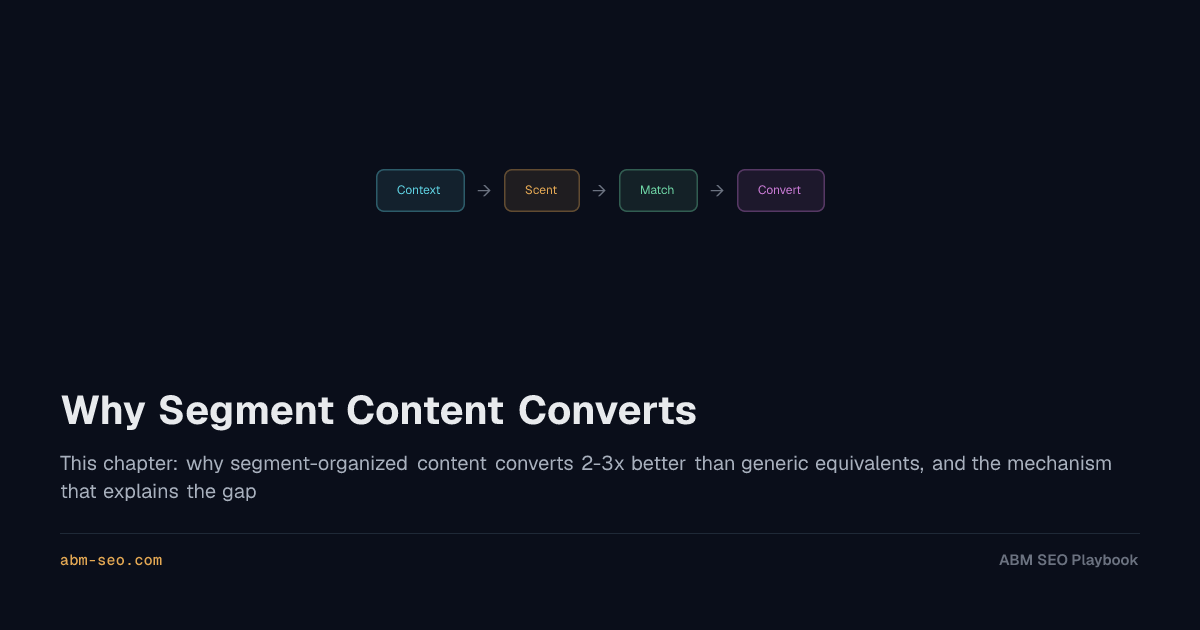
This chapter: why segment-organized content converts 2-3x better than generic equivalents, and the mechanism that explains the gap
Read by 98+ marketing leaders
Floryn Backbase Insify Mollie
Growth marketers building segment content programs/Walk away with: an understanding of why segment-organized content converts better, and how to use that mechanism deliberately
Two pages targeting the same keyword at the same position can have materially different conversion rates. Context is the variable that explains the gap.
People arrive carrying a job, a deadline, prior failed attempts, and a personal definition of success. The keyword is the surface. Context is the layer underneath.
Information scent (Pirolli and Card) explains why visitors bounce from generic pages even when the keyword matches perfectly.
ABM SEO is context-first SEO pushed to its endpoint: every page is built for a known audience carrying a known set of pressures.
I used to teach the standard four-intent model: informational, navigational, transactional, commercial investigation. Map each query to one of the four, match the page type to the intent, optimize accordingly. I taught keyword research courses built entirely on this model.
The limit showed up in client work. Two pages targeting the same keyword, same intent classification, same search volume, materially different conversion rates. The four-intent model could not explain the gap because it stopped at the query. It never asked who typed it, what pressure they were under, or what they had already tried.
Intent tells you what the query wants. It does not tell you what the person needs.
Three concepts stack on each other. Most SEO practice only uses the first two.
Search intent answers: what does this query want? It is a property of the query. Useful, but query-bound.
Semantic SEO answers: what is the topic neighborhood, and which entities belong in it? Useful, but page-bound.
Context-first SEO answers: who is this person, what are they carrying when they search, and where are they in their decision? It is a property of the human. It absorbs intent and semantics and sits one layer above them.
The order matters: context first, then semantics to express it on the page, then intent to make sure the query maps cleanly to what you have built.
This is not a rejection of keyword data. I still start with GSC and DataForSEO. Context tells me which of the keywords actually matter and how to write the page once I have picked them. It is not a license to skip research and write from imagination. Context comes from sales calls, support tickets, customer interviews, Reddit threads, LinkedIn comments, and the client’s own CRM data. If I cannot point to where the context came from, I am guessing.
Before building any content cluster, I map four layers per segment. Each layer has its own input source, and each one changes how the page gets written.
Life context
What is happening in this person’s world when they search?
New role, post-acquisition integration, quarter-end pressure, hiring freeze, board prep. The macro situation the search sits inside. A VP of Marketing who just started in a new role searches differently than one who has been in seat for three years, even if they type the same query.
Pressure
What specific pressure are they under?
Pipeline target they are behind on, churn risk they need to explain, a competitor that just raised a round, a CEO who asked a question they cannot answer yet. The thing that made today the day they searched. Pressure determines urgency, and urgency determines what kind of page holds attention.
Prior attempts
What have they already tried?
Which tools, which agencies, which internal projects failed or stalled. Context-first content has to start where the reader actually is, not where the funnel diagram says they should be. A page that opens with basics when the reader already tried two agencies and a tool is a page that gets closed in seven seconds.
Personal definition of success
What does winning look like for this person, not just for the company?
Keeping their job, getting promoted, not being the one who picked the wrong vendor, being seen as the person who solved this. The professional reason and the personal reason are usually different. Both matter. The professional reason gets them to the page. The personal reason gets them to the form.
People scan the web like animals foraging for food. They follow information scent: small cues in titles, headings, opening paragraphs, and proof elements that tell them whether this page is likely to have what they need in their specific situation. If the scent is weak, they leave. This model comes from Pirolli and Card’s work at Xerox PARC, and it explains far more about page performance than most SEO frameworks do.
Context is what makes the scent strong. A page that ranks well but smells generic to a CFO doing vendor evaluation under board pressure will not hold her. She will bounce within seven seconds, and the page gets filed under “did not speak to me.” The keyword matched. The context did not.
High impressions, low CTR in GSC: the title and meta description do not carry enough context for the searcher to recognize themselves in the SERP
Low scroll depth: the opening paragraph did not confirm the scent. The reader arrived, scanned, concluded “not for me,” and left
Pogo-sticking within 10 seconds: the page contradicted the promise of the snippet. The scent was there in the title but absent on the page
Short dwell time on pages with good rankings: ranking for the word, missing the person
When a page ranks but does not convert, the diagnosis is almost always a scent problem. The page attracted the right query but failed to signal that it understands the right person.
A page can rank for a keyword and still fail the person who typed it. The keyword is the surface. Context is the layer underneath. The gap between those two is where conversions are won or lost.
Here is the clearest illustration of why context changes everything, even when the keyword stays the same.
A page on “lead scoring” written for a RevOps lead at a Series B SaaS company sits in a semantic neighborhood of: MQL, SQL, pipeline velocity, attribution, fit-and-engagement model, lifecycle stage, Marketo, HubSpot Operations Hub, deal acceleration. The page assumes a CRM is in place, a marketing ops function exists, and the question is how to make scoring better.
A page on “lead scoring” written for a founder making their first sales hire sits in a semantic neighborhood of: first sales hire, CRM setup, what counts as a lead, qualifying questions, founder-led sales, when to hire a salesperson, simple spreadsheet alternative. The page assumes nothing is in place yet.
Same keyword. Two completely different humans. Two completely different pages. Both can rank. Only one will convert for a given audience, because the semantic neighborhood is the context signal that says “this page is for you” or “this page is not for you.”
This is not about writing two thin variants with swapped industry terms. The pages are genuinely different: different assumed starting points, different proof elements, different vocabulary, different depth. The content differentiation chapter covers the operational discipline of making these differences real rather than cosmetic.
Search volume measures who types today. Voice of customer measures who thinks about the problem. For enterprise B2B with concentrated ICPs, these are different populations.
?Which keyword is worth more?
Yes20 monthly searches, mentioned in 14 sales calls this quarter. A CISO evaluating audit-readiness tooling. This keyword closes deals.
No5,000 monthly searches, zero mentions in sales calls. A student writing a paper, a journalist backgrounding. This keyword fills dashboards.
Standard agency practice prioritizes by volume and misses the highest-conversion topics in the space. This is structurally wrong for enterprise B2B, where the buying committee is small, the deal size is large, and the decision cycle is long.
The practical test: if the keyword maps to a real person in a real buying moment, and you can name who that person is and what pressure they carry, the keyword has strategic value regardless of what the tool says about volume. If you cannot name the person, the keyword is abstract, and volume does not fix that.
This is why ABM SEO starts with CRM data instead of keyword tools. The CRM tells you which people are real. Keyword research validates whether those people are searchable. The order matters.
ABM SEO is context-first SEO pushed to its endpoint. Instead of writing for a broad segment, you are writing for a specific buyer type at a specific moment in their decision. The context layers collapse from population averages to a fully-known target profile.
Life context becomes “they just went through an acquisition.” Pressure becomes “the new CRO has a 90-day plan and needs a pipeline answer.” Prior attempts become “they trialed Competitor A in Q2 and churned.” Success becomes “the VP of Marketing wants to be the one who brought this solution in.”
This is why segment-specific pages achieve conversion rates 2-3x higher than generic equivalents. The context-to-content fit is as tight as it can get. Every chapter in the ABM content strategy follows from this principle. The content cluster architecture is the output of context mapping, not the input. A cluster is a context expressed in topics.
Not persona writing dressed up. Personas describe demographics. Context describes the moment.
Not a replacement for technical SEO. A page can have perfect context and still fail if it cannot be crawled. Context-first sits on top of working fundamentals.
Not a framework for skipping research. Context without keyword validation is storytelling. Keywords without context is commodity content. You need both, in the right order.
If you are building segment content and want to apply context-first thinking:
Pick one segment you are already building content for. Pull the CRM data, sales recordings, and support tickets for that segment.
Map the four context layers: life context, pressure, prior attempts, personal definition of success. Write them down. Be specific.
Audit your existing pages for that segment against the context map. Does the opening paragraph confirm the scent? Does the vocabulary match what this person actually says? Does the page start where they actually are, or where the funnel says they should be?
Rewrite the weakest page first. Not from scratch. Adjust the opening, the examples, the assumed starting point, and the semantic neighborhood to match the context you mapped.
The gap between a page that ranks and a page that converts is almost always a context gap. Closing it does not require new content. It requires understanding who is on the other side of the keyword.
Get notified when new chapters publish
By subscribing you agree to receive notifications when new chapters publish. Unsubscribe anytime.

 Floryn
  Backbase
  Insify
  Mollie